


The Rise of Central Bank Digital Currencies (CBDCs): What They Mean for Payments and Banking
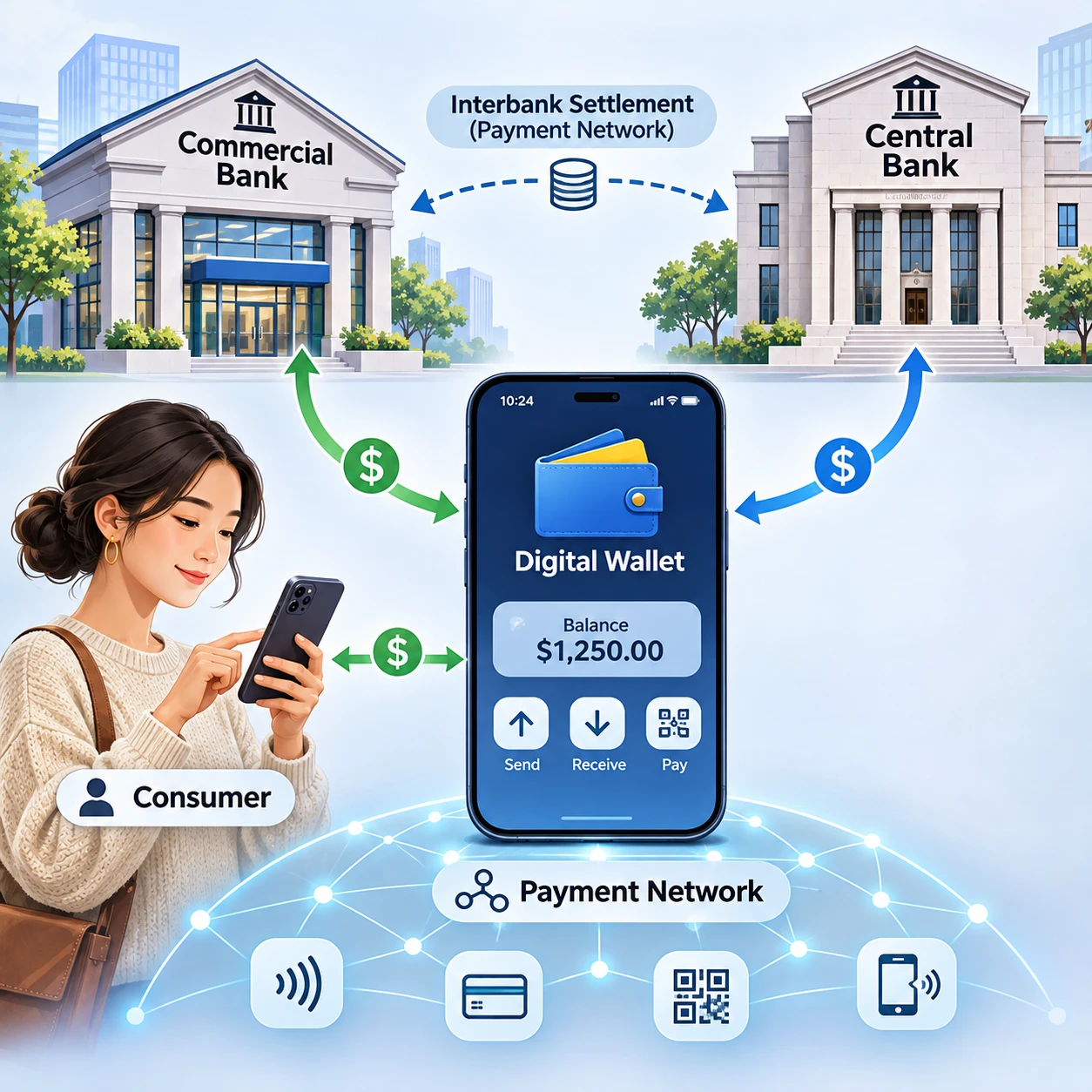
Central bank digital currencies, or CBDCs, are drawing attention as people, businesses, and governments rely more heavily on digital payments. They could offer a new way to use public money electronically, but there is no single CBDC model and no universal rollout. Each central bank must decide what a digital currency should do, who can use it, and how it fits alongside cash and existing bank accounts.
Understanding those choices matters more than predicting a single outcome. A retail CBDC could affect everyday payments, while a wholesale CBDC would target financial institutions and settlement systems. In either case, design decisions shape the balance between convenience, privacy, financial inclusion, and the role of commercial banks.
What is a central bank digital currency?
A central bank digital currency (CBDC) is a digital form of money issued by a country’s central bank and denominated in that country’s unit of account. It represents a direct claim on the central bank, much as physical cash does, although its form and method of use depend on the design.
Most people already make digital payments, but the money behind a card or bank-transfer transaction is usually a commercial bank deposit. A CBDC would be different because the central bank, rather than a commercial bank, would issue the digital money. Depending on the system, people might access it through a digital wallet or another approved payment service.
CBDC is an umbrella term, not a standard product. One design might support instant, low-value payments between consumers and shops. Another might be limited to financial institutions settling transactions. Some models could work online only; others may explore limited offline payments. These choices determine what a CBDC can do and which problems it is intended to solve.
Retail and wholesale CBDCs: What’s the difference?
Retail CBDCs are designed for use by the public, while wholesale CBDCs are intended for financial institutions. The distinction is mainly about users and payment purpose, not whether the currency is digital.
Retail CBDCs for everyday payments
A retail CBDC could be used by individuals and businesses for payments such as buying groceries, paying a bill, or sending money to another person. It might be distributed directly by a central bank or through commercial banks and payment providers. In an intermediary model, people would interact with familiar service providers while the central bank remains the issuer of the money.
Wholesale CBDCs for financial institutions
A wholesale CBDC would serve banks and other eligible institutions. Its potential uses include settling payments between financial firms or supporting the settlement of securities transactions. These systems could change how institutions coordinate payment and asset transfers, but the benefits depend on technical design, legal rules, and whether different systems can work together.
The practical takeaway: a consumer deciding how to pay would care more about a retail CBDC. A bank or market operator would focus more on wholesale settlement. Progress in one area does not mean a public-facing currency is ready or planned.
How CBDCs differ from cash, bank deposits, and cryptocurrency
The main difference is who issues the money and what claim it represents: cash and a CBDC are central bank money, bank deposits are commercial bank liabilities, and cryptocurrencies are generally issued outside central banking systems. Their payment features and protections also vary.
- Cash: Physical notes and coins issued by a central bank. Cash can often be used without an internet connection and supports in-person payments, but it is less suited to remote digital transactions.
- Bank deposits: Balances held at commercial banks. People use them through cards, transfers, and payment apps. A deposit is a claim on the bank, subject to the relevant legal and account-protection framework.
- CBDCs: Digital central bank money. A retail CBDC could make a central-bank claim available electronically to the public, depending on the model and access rules.
- Cryptocurrency: A broad category of digital assets, often using decentralized networks. Cryptocurrencies are not generally liabilities of a central bank, and their prices and legal treatment can differ substantially from public money.
Digital payment technology alone does not make money a CBDC. A payment app can move commercial bank deposits, while a cryptocurrency can transfer a privately issued digital asset. The issuer and underlying claim are the key distinctions.
Why central banks are exploring CBDCs
Central banks are exploring CBDCs to understand whether public digital money could improve payment systems, preserve access to central bank money, or strengthen payment resilience. The motivations differ by country, and research does not guarantee a launch.
As digital payments become more common, cash may play a smaller role in routine purchases. Some central banks are examining whether people should still have a digital way to access public money, alongside bank deposits and private payment services. Others are investigating payment speed, cost, competition, or access for people who face barriers to existing financial services.
Resilience is another consideration. A well-designed payment system could offer an additional channel if existing services are disrupted, though a CBDC would still need reliable infrastructure, cybersecurity, and clear operating procedures. Offline functionality might help in limited circumstances, but it can introduce risks such as spending the same funds twice unless controls are carefully designed.
Cross-border payments also attract interest because transfers between countries can involve multiple intermediaries, rules, and currencies. CBDC arrangements might help with some settlement processes, but they cannot remove differences in regulation, identity requirements, or foreign-exchange arrangements by themselves.
Potential benefits and challenges
CBDCs could add a public digital payment option, but they also raise questions about privacy, security, access, and adoption. Their effects depend on specific safeguards and operating choices, so benefits should be treated as possibilities rather than guaranteed results.
Potential benefits
- Payment choice: A retail CBDC could provide another way to make digital payments, alongside cash, cards, and bank transfers.
- Financial inclusion: Depending on access rules and design, a CBDC might help people who have limited access to traditional banking. A device, internet connection, identity document, or accessible support may still be required, so a digital currency alone cannot solve exclusion.
- Resilience and competition: An additional public payment option could diversify the payment landscape. Its value would depend on whether people and merchants can use it easily and whether the system remains available during disruptions.
Key challenges
- Privacy: Digital payments create records that cash generally does not. A CBDC’s privacy depends on what information is collected, who can access it, how long it is retained, and what legal safeguards apply.
- Cybersecurity: A CBDC would need protection against fraud, cyberattacks, outages, and operational failures. Strong security can add cost and complexity, and no system can eliminate risk entirely.
- Adoption and accessibility: People and businesses may not see a reason to switch if existing payment methods work well. A usable system must account for people without smartphones, stable connectivity, or confidence with digital tools.
There is no automatic privacy outcome. A CBDC could be designed with different levels of data protection, but the details matter: payment limits, intermediaries, identity checks, and access by authorities all influence how it works in practice.
What CBDCs could mean for banks and consumers
A CBDC could give consumers another payment option and could change how banks distribute money and serve customers, but the impact depends on design. In particular, access rules and any limits on CBDC balances could influence whether people move money out of commercial bank deposits.
Commercial banks currently provide many everyday services, including deposit accounts, payment tools, lending, and customer support. A CBDC distributed through banks or other intermediaries could preserve much of that customer-facing role. A more direct model might change how people access central bank money, though it would still need clear systems for onboarding, support, and payments.
For consumers, the practical difference might be modest if a CBDC works through a familiar wallet and offers similar checkout options. It could matter more if it supports new payment functions, works in situations where other services are unavailable, or has different privacy and access terms. Before using any future CBDC, consumers should check who provides the wallet, how transactions are handled, and what recourse exists if something goes wrong.
For banks, widespread movement of deposits into CBDC could affect funding, particularly during periods of financial stress. Policymakers may consider design features such as holding limits or rules on interest to manage that risk. These measures bring trade-offs: a limit may reduce deposit shifts but also make the CBDC less useful for some payments.
Where CBDC development is heading
CBDC development spans early research, technical experiments, pilots, and live systems; these stages should not be treated as equivalent. Some central banks are studying designs, while others test limited use cases, and a smaller number have introduced CBDCs under specific national arrangements.
There is no single global timetable or standard design. A central bank may research a retail CBDC without deciding to issue one, or test a wholesale application without creating a currency for public use. A pilot usually tests selected features with a limited group or setting; it does not prove that a system is ready for nationwide use.
Readers can track developments through official central bank and government announcements. Look for precise terms such as research, proof of concept, pilot, launch, and available to the public. They describe different levels of progress. For a broader overview of how central banks are approaching the topic, consult the Bank for International Settlements’ CBDC resources.
For payments and banking, the most useful question is not whether every country will adopt a CBDC. It is what problem a particular proposal aims to solve, what protections it offers, and whether it provides enough value to earn a place beside cash, bank deposits, and existing digital payments.