Open Banking Explained: What It Means for Consumers and Businesses
Banking used to be a closed system. Your financial data sat inside one institution, locked away from any tool or service that might actually help you use it better. Open Banking changes that — and understanding how it works puts you in a much stronger position as a consumer or business owner navigating today's digital financial landscape.
What Is Open Banking?
Open Banking is a system that allows banks to share customer financial data with authorized third-party providers — but only with the customer's explicit consent. It turns your bank account into something more like a platform, where approved apps and services can read your transaction history, initiate payments, or verify your account balance without you ever handing over your login credentials.
The concept sounds technical, but the practical reality is already familiar to millions of people. When you connect a budgeting app to your current account, or authorize a payment service to pull funds directly from your bank, you're using Open Banking in action.
At its core, it's about giving customers control over their own financial data — and enabling a broader ecosystem of financial tools to compete on quality rather than on who holds the most data.
How Open Banking Actually Works
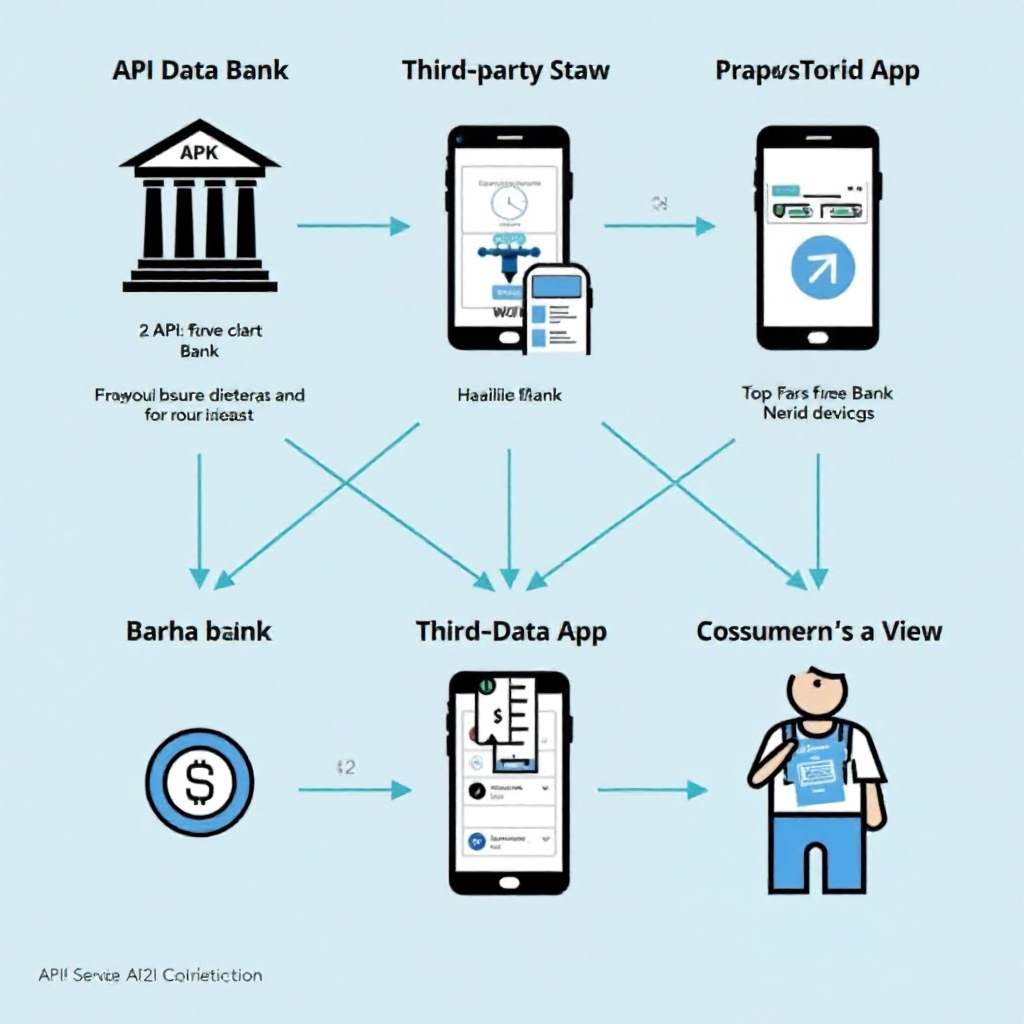
The mechanism behind Open Banking is the Application Programming Interface, or API. An API is essentially a secure digital bridge that lets two software systems talk to each other. In this context, it connects your bank's systems to a third-party app — passing only the specific data that's been authorized, nothing more.
Here's a simplified version of what happens when you link a personal finance app to your bank account:
- You open the app and choose to connect your bank account.
- The app redirects you to your bank's own login page — you authenticate directly with the bank, not through the app.
- You select what data to share (for example, transaction history for the last 90 days).
- The bank issues a secure token to the third-party provider, granting limited, time-bound access.
- The app reads your data through the API and displays it — without ever seeing your password.
This is a meaningful departure from the older practice of "screen scraping," where apps would ask for your full login credentials and log in on your behalf. The API model is both more secure and more transparent about what's being accessed.
Key Regulations Driving Open Banking (PSD2 and Beyond)
Open Banking didn't emerge organically — it was largely mandated by regulation. PSD2 (the Payment Services Directive 2), which came into force across the European Union in 2018, requires banks to provide secure API access to authorized third-party providers. It also introduced strong customer authentication rules to protect consumers during digital transactions.
The UK developed its own Open Banking framework through the Competition and Markets Authority, which has become one of the most mature implementations globally. Similar frameworks are now active or in development across Australia, Canada, Brazil, and parts of Southeast Asia — though the scope and pace vary significantly by region.
What these regulations share is a common logic: financial data generated by a customer belongs to that customer, not exclusively to the bank. Regulation creates the baseline trust and standardization that makes the whole system function reliably.
What Open Banking Means for Consumers
For everyday consumers, Open Banking translates into more useful financial tools and greater control over personal data. The most immediate benefits show up in a few specific areas.
Account aggregation is one of the clearest wins. Instead of logging into three different banking apps to get a complete picture of your finances, aggregation tools pull data from multiple accounts into a single dashboard. This is particularly useful if you hold accounts at different institutions or have a mix of current accounts, savings, and credit products.
Budgeting apps that categorize your spending automatically, flag unusual transactions, or project your end-of-month balance all rely on the same underlying data access. The quality of these tools has improved substantially as API-based access replaced the clunkier screen-scraping approach.
Open Banking also powers faster, lower-cost payments. When you pay a merchant directly from your bank account through an e-wallet or payment app — bypassing the card network entirely — that's often an Open Banking-enabled transaction. For consumers, this can mean fewer friction points at checkout. For merchants, it typically means lower transaction fees than card payments.
The data privacy angle deserves honest attention. Sharing financial data always carries some risk, and not every third-party provider has the same security standards. The key protection is consumer consent — you choose what to share, with whom, and for how long. Reputable providers operating under PSD2 or equivalent frameworks must be licensed and audited. But it's still worth reading what you're agreeing to before connecting any app to your bank.
What Open Banking Means for Businesses
Businesses — particularly small and medium-sized enterprises — stand to gain significantly from Open Banking, though the benefits look different from the consumer side.
Payment collection becomes simpler and cheaper. A small business accepting payments via Open Banking-enabled tools can receive funds directly from a customer's bank account, often settling faster than card payments and with lower processing fees. For businesses running on thin margins, this matters.
Cash flow visibility improves when accounting software connects directly to business bank accounts via API. Real-time transaction data replaces the manual process of importing bank statements, and reconciliation becomes considerably less painful. Some platforms can flag late-paying clients or flag when a supplier payment has cleared — automatically, without anyone checking a spreadsheet.
Customer onboarding is another area where Open Banking delivers practical value. Verifying a new customer's identity and income through bank data — with their consent — is faster and often more accurate than asking for payslips or bank statements. Lenders, landlords, and subscription services are increasingly using this approach to reduce friction in the sign-up process.
One honest trade-off: businesses that want to integrate Open Banking capabilities need to work with regulated third-party providers or become licensed themselves. The compliance overhead is real, and smaller businesses will typically rely on fintech platforms to handle the technical and regulatory complexity on their behalf.
Open Banking and the Future of Digital Payments
Open Banking is already reshaping the payments landscape, and the trajectory points toward deeper integration with the broader fintech ecosystem. Digital wallets and e-wallets increasingly use Open Banking rails to fund accounts or initiate payments — reducing dependence on card networks and enabling near-instant transfers in supported markets.
Embedded finance is one of the more significant developments building on Open Banking infrastructure. This is what happens when financial services — lending, insurance, payments — appear inside non-financial platforms. A logistics company offering invoice financing directly within its software, or a retail platform providing instant credit at checkout, are both examples of embedded finance that Open Banking makes technically feasible.
Buy Now Pay Later services also benefit from Open Banking data, using real-time bank account information to make faster, more accurate credit assessments than traditional credit scoring allows.
The direction is toward an increasingly connected financial ecosystem where data flows more freely between institutions and services — always with consent, ideally with strong security standards, and with more competition driving better products for end users.
Is Open Banking Safe? Key Risks and Protections
Open Banking is designed with security as a foundational requirement, but that doesn't mean it's risk-free. Understanding the protections — and the gaps — helps you make informed decisions about which services to trust.
The core security architecture relies on several layers. APIs use encryption to protect data in transit. Authentication happens directly with your bank, not through the third party. Access tokens are time-limited and scoped — a budgeting app granted read-only access to your transactions cannot initiate payments on your behalf. And crucially, you can revoke access at any time, either through the third-party app or directly through your bank's settings.
Regulated third-party providers operating under PSD2 or equivalent frameworks must meet specific security and operational standards and carry liability if something goes wrong on their end. This is a meaningful protection compared to unregulated alternatives.
The risks worth watching:
- Phishing and fake apps that mimic legitimate Open Banking services to steal credentials — always verify you're using a licensed provider.
- Over-sharing — granting broader data access than a service actually needs. Check permissions carefully before connecting.
- Forgotten connections — apps you authorized years ago may still have active access. Periodically reviewing and revoking unused permissions is good practice.
For most consumers using reputable, regulated services, the practical risk is low. The consent-and-control model is a genuine improvement over older approaches to financial data sharing — provided you stay engaged with what you've authorized.
Frequently Asked Questions
Do I need to opt in to Open Banking, or is it automatic?
Open Banking always requires your explicit consent. Your bank cannot share your data with third parties without your authorization. You opt in each time you connect a new app or service, and you control what data is shared and for how long.
Which apps and services use Open Banking?
Budgeting and personal finance apps, account aggregation tools, some e-wallets, payment initiation services, and certain lending platforms all commonly use Open Banking. The specific services available depend on your country and which banks participate in the local framework.
Can I revoke a third party's access to my bank data?
Yes. You can revoke access at any time — either through the third-party app's settings or directly through your bank's online portal. Once revoked, the provider can no longer access your data, though they may retain previously collected information according to their privacy policy.
Is Open Banking available worldwide or only in certain regions?
Open Banking is most developed in the UK and EU (under PSD2), but frameworks exist or are emerging in Australia, Brazil, Canada, Singapore, and other markets. The US has no single federal mandate, though the Consumer Financial Protection Bureau has been developing related rules. Coverage and capabilities vary significantly by region.
How is Open Banking different from traditional bank transfers or card payments?
Traditional card payments route through card networks (Visa, Mastercard) with associated fees and processing delays. Standard bank transfers are direct but often require manual entry of account details. Open Banking-enabled payments use APIs to initiate transfers directly from a bank account, typically with lower fees, faster settlement, and without sharing card details with the merchant.