

The Impact of Blockchain on Traditional Banking
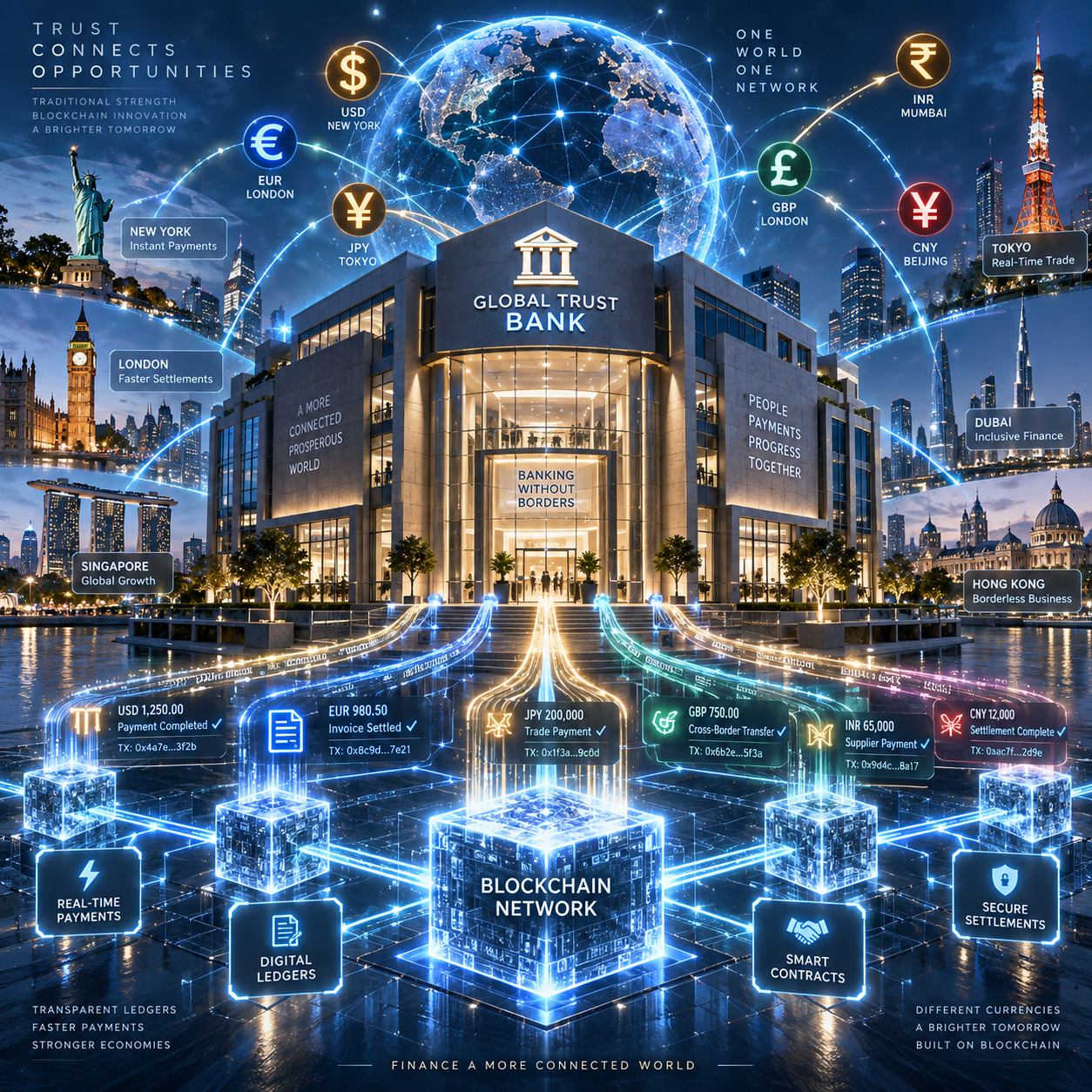
Blockchain technology is changing how financial institutions think about payments, records, settlement, and customer data. Its influence is unlikely to arrive as a sudden replacement for traditional banks. More realistically, banks will combine selected blockchain systems with existing databases, payment rails, compliance tools, and branches.
The most important question is practical: where can a shared, tamper-resistant ledger solve a banking problem better than a conventional centralized system? The answer increasingly involves cross-border payments, transaction settlement, trade finance, identity verification, and programmable financial contracts.
What Is Blockchain and How Does It Relate to Banking?
Blockchain is a distributed ledger that records transactions across a network of computers, while traditional banks usually maintain centralized databases controlled by one institution. In banking, blockchain is best understood as a method for sharing and verifying records, not as a synonym for cryptocurrency.
A conventional bank typically records a payment in its own database. If the transaction involves another bank, each institution keeps a separate record and later reconciles the two versions. Correspondent banks, clearing systems, payment processors, and central infrastructures may add further steps.
Blockchain uses distributed ledger technology, or DLT, to maintain a synchronized record among authorized participants. A transaction is validated according to network rules, grouped with other transactions, and linked to earlier records. Once confirmed, changing the history becomes difficult because the network must recognize the alteration.
Regulated banks will often favor permissioned blockchain networks rather than open public blockchains. A permissioned network can restrict participation, apply identity checks, manage access rights, and support banking regulation. It can also provide greater control over performance and data privacy.
That design creates a trade-off. A permissioned ledger may offer stronger governance and predictable access, but it does not provide the same open participation associated with some public blockchain networks. The value comes from coordinated recordkeeping between trusted institutions.
How Blockchain Could Improve Banking Operations
Blockchain could improve banking operations by reducing duplicated records, automating verification, and allowing authorized institutions to settle transactions from a shared source of truth. The gains are most plausible in processes that currently involve several parties and repeated reconciliation.
In conventional banking, reconciliation compares records held by different institutions. This work can involve files, exception queues, manual investigations, and delayed updates. A shared ledger may reduce the need to compare separate records because participants view the same transaction history.
Potential operational benefits include:
- Faster settlement: Payment or asset transfers may move closer to real time when clearing and settlement occur on a connected ledger.
- Lower reconciliation effort: Banks can reduce duplicate recordkeeping and investigate fewer mismatches.
- Improved transparency: Authorized participants can track transaction status and ownership changes more consistently.
- Automated controls: Smart contracts can apply predefined conditions, such as releasing funds after verified delivery documents arrive.
- Auditability: A chronological record can make it easier to review who approved or changed a transaction.
These benefits are not automatic. A blockchain network still needs accurate information at the point of entry. If a shipping document, identity record, or account instruction is false, an immutable ledger may preserve the wrong information efficiently. Banks therefore still need strong onboarding, data validation, governance, and human oversight.
Blockchain’s Impact on Payments and Cross-Border Transfers
Blockchain may make cross-border payments more traceable and reduce some intermediary steps, but speed depends on liquidity, compliance checks, currency conversion, and the networks connected to the transaction. The technology addresses record coordination; it does not remove every practical barrier to international payments.
Traditional international transfers may pass through correspondent banks in several jurisdictions. Each intermediary can apply screening, maintain a ledger, deduct a fee, and wait for confirmation from another participant. Differences in operating hours, messaging standards, and settlement accounts can create delays.
A blockchain-based payment arrangement could allow participating banks to share transaction status on a common network. Tokenized deposits or regulated digital representations of fiat currency could move alongside payment instructions, reducing the gap between messaging and settlement.
This model may improve:
- Payment tracking for banks and customers.
- Visibility into fees, exceptions, and settlement status.
- Availability outside traditional batch-processing windows.
- Coordination between banks using a common settlement asset.
However, blockchain does not automatically eliminate foreign-exchange risk, sanctions screening, know-your-customer obligations, or local reporting requirements. A transfer can be technically fast but still wait for compliance approval or sufficient liquidity. Public networks may also face variable fees, congestion, privacy concerns, and uncertain legal treatment.
For that reason, the strongest near-term applications are likely to use regulated participants and clearly defined settlement assets. Blockchain can streamline the payment chain, but banks must still connect it to existing payment systems and national rules.

Key Banking Use Cases for Blockchain
The main banking use cases for blockchain include transaction settlement, trade finance, identity verification, smart contracts, asset tokenization, and fraud monitoring. Each application works best when several institutions need a shared record and agreed rules.
Transaction settlement and securities
Blockchain could record the transfer of bonds, equities, or other financial assets while coordinating payment. This may shorten the interval between trade execution and final settlement. The benefit depends on whether exchanges, custodians, brokers, banks, and regulators use compatible systems.
Trade finance
Letters of credit, bills of lading, invoices, and customs records often move between exporters, importers, banks, insurers, and logistics providers. A shared ledger can help participants verify document status and trigger financing decisions. Smart contracts may release funds when agreed conditions are confirmed.
Identity verification and fraud monitoring
Financial institutions repeatedly verify customer information during account opening, lending, and payment activity. A permissioned identity framework could let approved institutions confirm selected credentials without copying every underlying document. Privacy controls are essential because a blockchain record should not expose sensitive personal data to unnecessary participants.
Asset tokenization
Tokenization represents ownership of an asset or financial claim digitally. Banks may use it for bonds, deposits, funds, or other regulated instruments. Tokenization can support fractional ownership and automated transfer, but legal ownership, investor protection, custody, and redemption must remain clear.
Smart contracts
Smart contracts are software rules that execute actions when specified conditions are met. A bank could use one to calculate interest, check collateral requirements, or distribute payments. They require careful testing because an error in the code can produce an incorrect financial result at scale.
Challenges and Risks for Traditional Banks
The main blockchain risks for traditional banks are scalability, interoperability, privacy, cybersecurity, regulatory uncertainty, and the cost of integrating new infrastructure. These challenges explain why many banks test targeted projects instead of replacing core systems immediately.
- Scalability: A network must process high volumes reliably during peak demand without excessive fees or delays.
- Interoperability: Different blockchain platforms and legacy banking systems need common standards for identity, messaging, assets, and settlement.
- Privacy: Financial transactions contain sensitive information. Banks may need permission controls, encryption, selective disclosure, or off-chain storage.
- Cybersecurity: Distributed architecture can improve resilience, but wallets, interfaces, smart contracts, administrator keys, and connected databases remain attack targets.
- Regulation: Banking regulation must address legal ownership, finality, consumer protection, data retention, anti-money-laundering controls, and responsibility when code fails.
- Integration cost: Connecting a new ledger to core banking, card networks, treasury systems, and compliance platforms can require substantial investment and specialist skills.
There is also an operational risk: immutability can make mistakes harder to correct. Traditional banks can often reverse or amend an entry through controlled procedures. Blockchain applications need carefully designed correction, dispute, and recovery processes that preserve auditability without locking in fraud or clerical errors.
Blockchain vs. Traditional Banking Systems
The central difference is control: traditional banking systems rely on institution-managed databases, while blockchain distributes agreed records across authorized participants. Neither model is superior for every banking function.
| Area | Traditional banking | Blockchain-enabled model |
|---|---|---|
| Control | Usually managed by one bank or central operator | Shared among approved network participants |
| Settlement | May involve separate clearing and reconciliation steps | Can combine record sharing with near-continuous settlement |
| Transparency | Records are visible according to each institution’s systems | Authorized parties can view a common transaction history |
| Privacy | Access is controlled within centralized databases | Requires carefully designed permissions and data architecture |
| Customer experience | Familiar accounts, protections, and support channels | Potentially faster tracking and programmable services, with new complexity |
Centralized systems can be efficient when one trusted operator already coordinates all participants. Blockchain becomes more attractive when multiple organizations need a shared record but do not want one party to maintain the only authoritative database.
The Future Relationship Between Blockchain and Banks
The future relationship between blockchain and banks will likely involve selective integration rather than an immediate replacement of traditional banking. Banks are most likely to adopt blockchain where it improves settlement, asset movement, compliance coordination, or programmable payments without weakening customer protections.
Central bank digital currencies, or CBDCs, may influence this transition. A CBDC is a digital form of central bank money, while a commercial-bank deposit and a cryptocurrency are different instruments with different issuers and risks. CBDC design could affect payment speed, privacy, monetary policy, bank funding, and the role of intermediaries.
Commercial banks may also develop tokenized deposits, shared settlement networks, and digital securities platforms. These systems could operate alongside card networks, instant-payment schemes, bank transfers, and existing core banking infrastructure.
A useful adoption test is the three-part fit: first, does the process involve multiple parties; second, does reconciliation create measurable friction; and third, can governance, privacy, and regulation be defined clearly? If the answer to all three is yes, blockchain deserves serious consideration. If one answer is no, a conventional database may remain simpler and safer.
Frequently Asked Questions
Will blockchain replace traditional banks?
Blockchain is unlikely to replace traditional banks in the near term. Banks provide lending, deposit services, compliance, customer support, risk management, and access to regulated payment infrastructure. Blockchain may change how these services are delivered.
How does blockchain make payments faster?
Blockchain can reduce delays by sharing transaction records among participants and automating settlement conditions. Actual speed still depends on compliance checks, liquidity, foreign-exchange conversion, network capacity, and local regulations.
Is blockchain more secure than traditional banking systems?
Blockchain can make unauthorized historical changes more difficult and improve auditability. It does not eliminate cybersecurity risks. Keys, applications, smart contracts, identity systems, and user devices still require strong protection.
What are the main barriers to blockchain adoption in banking?
The main barriers are regulatory uncertainty, privacy requirements, scalability, interoperability, integration costs, governance disagreements, and the difficulty of correcting errors on an immutable ledger.
How could CBDCs affect banks and payments?
CBDCs could provide a new form of digital central bank money and support faster or more programmable payments. Their effect on commercial banks would depend on design choices such as holding limits, access rules, privacy, remuneration, and the role of banks as intermediaries.
Blockchain’s impact on traditional banking will therefore be measured less by dramatic disruption than by better coordination in specific financial processes. The institutions that gain the most will be those that match the technology to a real operational problem, test it under regulatory controls, and keep customer security at the center.