
Biometric Authentication in Banking: Future or Reality?
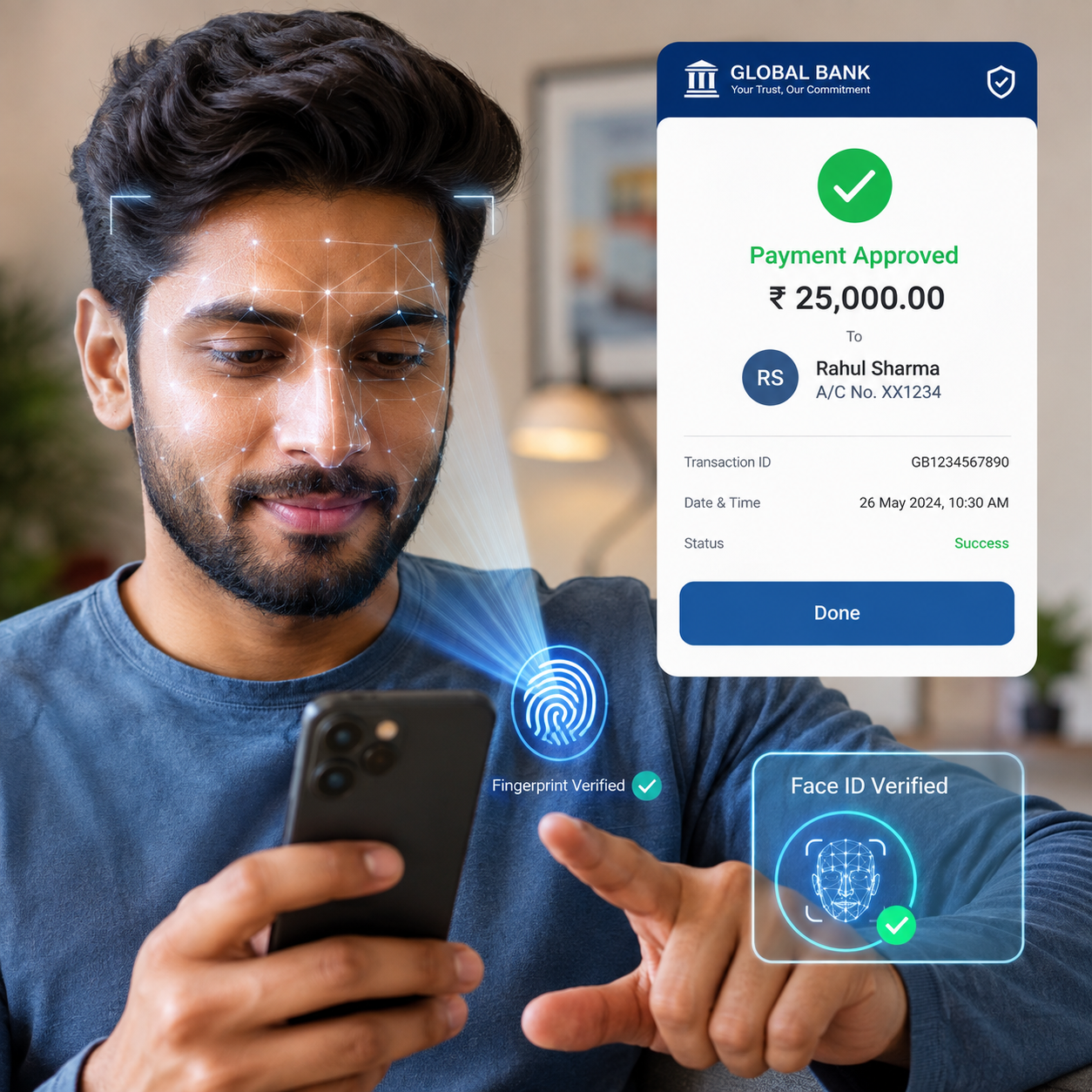
Biometric authentication in banking has moved beyond science fiction. Customers already unlock mobile banking apps with a fingerprint, approve payments with facial recognition, and use voice recognition for selected services. The technology is practical today, although its long-term role depends on privacy safeguards, device security, regulation, and customer choice.
For banks, biometrics offers a way to verify a person without relying entirely on passwords or PINs. It can make routine access faster, but it does not eliminate fraud or replace every other security control. The strongest approach combines biometrics with device checks, transaction monitoring, and risk-based authentication.
What Is Biometric Authentication in Banking?
Biometric authentication in banking verifies a customer by measuring a physical or behavioral characteristic, such as a fingerprint, face, voice, or typing pattern. It confirms that a person is likely the legitimate account user before granting access or authorizing an action.
Three related concepts are easy to confuse:
- Authentication asks, “Are you the person associated with this account?”
- Identification asks, “Which person in a known group is this?”
- Authorization asks, “Are you allowed to perform this transaction?”
Most mobile banking biometrics support authentication. A phone compares a live fingerprint or facial scan with a previously enrolled template, then tells the banking app whether the match is acceptable. The bank may never receive the raw fingerprint or face image. On many devices, the biometric check happens inside a protected hardware environment, while the app receives only a success or failure result.
Common biometric categories include fingerprint recognition, facial recognition, voice recognition, iris scanning, and behavioral biometrics. Behavioral biometrics can assess patterns such as typing rhythm, touchscreen gestures, device handling, or navigation habits. These signals are usually better suited to continuous risk assessment than to a single visible login screen.
How Banks Use Biometrics Today
To use biometrics today, banks usually connect a mobile app or customer-service system to a trusted device sensor, then apply the result to login, payment approval, recovery, or onboarding. The exact process varies by bank, country, device, and transaction risk.
Mobile banking login
A customer may enroll a fingerprint or face on a smartphone and use it instead of entering a password each time. This reduces friction for checking balances, reviewing statements, or moving between banking features. The account password normally remains available as a fallback.
Payment and transaction approval
Biometric approval can authorize a mobile payment, new payee, card-wallet purchase, or bank transfer. A low-risk action might need only the device biometric, while a large transfer could trigger an additional one-time password, security question, or out-of-band confirmation.
Customer onboarding and account recovery
During digital onboarding, some banks use facial recognition with an identity document and liveness detection to help confirm that the applicant is a real person. Banks may also use voice recognition or facial matching in customer-service workflows. These uses require careful consent, retention limits, and human review because a false match can delay legitimate access.
Behavioral biometrics often works quietly in the background. An unusual device, typing pattern, location, or navigation sequence may increase a fraud score and prompt stronger verification. It should support investigation rather than make unreviewable decisions about customers.
The Benefits of Biometric Banking Security
Biometric banking security can improve convenience, reduce dependence on memorized secrets, and strengthen fraud prevention when it operates as part of layered security. Its main advantage is usability, not magical protection.
- Faster access: A fingerprint or face scan can take seconds, avoiding repeated password entry on a small mobile screen.
- Fewer reused passwords: Customers who do not need to type a password for every session may be less likely to use short or repeated credentials.
- Stronger possession and inherence signals: A device check combined with a biometric trait can provide two different types of evidence: something the customer has and something they are.
- Better payment flow: Mobile payments and low-value approvals can become quicker without removing transaction monitoring or spending controls.
- Additional fraud signals: Behavioral biometrics and device intelligence can identify unusual activity before a bank approves a high-risk transaction.
There is a practical trade-off. Choosing biometrics for speed means accepting dependence on a compatible device, sensor accuracy, and a secure enrollment process. A biometric prompt may also encourage users to approve an action quickly without checking the payment recipient. Banks should display the amount and beneficiary clearly before authorization.
Customers can improve the benefit by enabling a strong device passcode, installing operating-system updates, using official banking apps, and reviewing transaction alerts. Biometrics is most useful when it removes routine friction while preserving a second line of defense for unusual events.
Security and Privacy Risks to Consider
Biometric authentication carries risks because biometric traits are permanent identifiers, while passwords can be replaced. Spoofing, device compromise, false matches, poor data handling, and coercion all need to be addressed through layered controls.
Spoofing and presentation attacks
A basic sensor may be fooled by a photograph, recording, lifted fingerprint, or artificial model. Modern systems use liveness detection and anti-spoofing controls, but no technology should be treated as perfect. Facial recognition can also perform differently across lighting conditions, cameras, and demographic groups.
Compromised devices and fallback methods
If someone gains control of an unlocked phone, the biometric layer may no longer provide meaningful protection. Attackers may also target password reset procedures, SIM swaps, or weak customer-service verification. The fallback route must be protected as carefully as the primary biometric method.
Privacy and storage
Customers should ask where biometric information is processed, whether the bank stores a raw image or a mathematical template, how long it is retained, and which providers can access it. Strong encryption, access controls, purpose limitation, deletion policies, and clear consent reduce data privacy risk. Regulatory expectations differ by jurisdiction; guidance from bodies such as the U.S. National Institute of Standards and Technology can help explain biometric evaluation and limitations.
A stolen biometric template cannot be changed like a password. That does not mean theft automatically gives an attacker account access, because templates and device protections may prevent direct reuse. It does mean banks should minimize collection and avoid treating biometric data as an ordinary password database.
Biometrics Compared With Other Authentication Methods
The main difference is the evidence each method uses: passwords and PINs rely on knowledge, one-time passwords add a temporary secret, and biometrics relies on a physical or behavioral trait. Multi-factor authentication combines different evidence types to reduce dependence on any single control.
| Method | Strengths | Limitations |
|---|---|---|
| Password | Flexible and replaceable | Can be reused, guessed, phished, or exposed |
| PIN | Fast and familiar | Short codes can be observed or guessed |
| One-time password | Temporary and useful for step-up checks | Can be intercepted through phishing, malware, or SIM attacks |
| Biometrics | Convenient and difficult to casually share | Cannot be reset like a password; sensors and matching can fail |
| Multi-factor authentication | Combines independent protections | Adds friction and requires careful design |
Biometrics should generally complement rather than replace all other methods. For example, a mobile banking app may require a registered device plus fingerprint recognition for routine access, then request a one-time password or manual review for a new beneficiary and unusually large transfer.
Customers should also understand that a biometric is not automatically multi-factor authentication. A face scan alone is one factor. A face scan on a registered device can represent two factors only when the bank treats the device possession and biometric verification as separate, meaningful checks.
What Is Limiting Wider Adoption?
Wider adoption is limited by customer trust, accessibility, device compatibility, regulation, integration costs, and inconsistent accuracy. Banks must prove that biometrics solves a real customer problem without creating a larger privacy or exclusion problem.
- Trust: Some customers do not want a bank or technology provider handling biometric information, especially when data-use policies are unclear.
- Accessibility: A customer may have a disability, injury, vision limitation, speech condition, or other reason that makes one biometric method unreliable.
- Device variation: Older phones, damaged sensors, poor lighting, gloves, masks, and noisy environments can affect performance.
- Regulatory duties: Financial institutions must address consent, data minimization, discrimination risks, breach response, and customer redress.
- Integration costs: Banks need secure links among mobile apps, identity systems, fraud engines, call centers, payment networks, and legacy platforms.
- Operational accuracy: False rejections frustrate legitimate customers, while false acceptances create security exposure. Neither metric can be judged in isolation.
The best rollout gives customers a clear alternative, such as a strong password, PIN, hardware security key, or assisted verification. It also explains what happens when a scan fails. Accessibility is a security feature: customers who cannot use the default method should not be pushed toward weaker workarounds.
Future or Reality? The Likely Role of Biometrics in Banking
Biometric authentication in banking is already a reality for mobile login, payment approval, onboarding, and fraud detection, but it is unlikely to become a universal replacement for passwords and PINs. Its future will center on risk-based, layered authentication with privacy protections and customer choice.
Expect banks to combine fingerprint recognition, facial recognition, voice recognition, behavioral biometrics, device intelligence, transaction history, and real-time fraud prevention. A familiar low-value payment may pass with a quick biometric check. An unusual international transfer may require several signals and human review.
The strongest model follows a simple rule: match the security step to the risk of the action. Convenience matters when a customer checks a balance. More friction is reasonable when changing a phone number, adding a payee, or sending a large amount.
Customers should judge a biometric banking feature by four questions:
- Does the bank explain how biometric data is processed and protected?
- Can the customer use a safe alternative if the biometric fails or feels inappropriate?
- Does the bank add stronger checks for unusual or high-value transactions?
- Can the customer review, challenge, and recover from a mistaken decision?
Biometrics has earned a place in modern banking because it can make secure behavior easier. It will remain dependable only when banks treat it as one component of banking security, maintain robust fallback controls, and respect data privacy. The likely future is therefore neither total replacement nor rejection: it is selective biometric authentication embedded in a broader, customer-centered security system.
Frequently Asked Questions
Is biometric authentication secure for mobile banking?
It can be secure when the bank uses a protected device, liveness checks where appropriate, strong enrollment, encrypted systems, transaction monitoring, and safe fallback methods. Customers should still use a strong device passcode and check transaction details before approving.
Can biometric banking data be stolen?
Biometric templates or related personal data can be exposed if a bank, device, or service provider suffers a breach. Good systems limit raw-data storage and use encryption and access controls. Because biometric traits cannot be replaced easily, minimizing collection is essential.
Are fingerprints safer than passwords?
Fingerprints are often more convenient and harder to share casually, but they are not automatically safer in every situation. A strong, unique password is replaceable, while a fingerprint is permanent. The outcome depends on device security, enrollment, fallback procedures, and fraud controls.
What happens if biometric authentication fails?
The banking app should offer a secure alternative, such as a PIN, password, passcode, or additional verification. Repeated failures may trigger a temporary block or customer-support review. Never use an unverified link or caller who asks for your full credentials as a workaround.
Will biometrics replace passwords and PINs?
Biometrics will reduce password and PIN use in many routine banking journeys, especially on smartphones. Passwords, PINs, recovery procedures, and one-time passwords will likely remain important backups and step-up controls for failed, unusual, or high-risk transactions.