

How to Spot Unreliable Health Information Online: A 2026 Guide to Evaluating Wellness Websites and Digital Resources in the United States
I've spent years watching people I care about — friends, family members, neighbors — make real health decisions based on whatever they stumbled across on some random website. And I'll be honest: it scares me more now than it ever did. In 2026, the problem isn't just bad information sitting in dusty corners of the internet. It's polished, well-formatted, algorithmically boosted content that looks like it came from a doctor's office. AI-generated health articles have flooded the web, and a lot of them are genuinely indistinguishable from the real thing — unless you know what you're looking for. This guide is my attempt to hand you the tools I wish someone had given me earlier.
Why Health Misinformation Is More Dangerous Than Ever in 2026
Recent surveys show that over 80% of American adults turn to online sources first when they notice a new symptom or want to understand a condition. That number is striking on its own. But the real issue in 2026 is what those people are actually finding. AI-generated health content — articles, social posts, YouTube scripts, even full 'wellness guides' — can now be produced in seconds by language models that have no medical training, no accountability, and no one checking their work. The result looks polished. It cites-sounding statistics. It reads like an expert wrote it. Often, no expert was involved at all.
The consequences aren't abstract. Delayed diagnoses happen when people self-treat based on bad information. Dangerous supplement interactions occur when someone follows advice from an unvetted website instead of their pharmacist. Vaccine hesitancy gets amplified by coordinated misinformation campaigns that are getting harder to distinguish from legitimate health journalism. When a person reads that some 'natural remedy' can replace insulin management for their diabetes — and believes it — the stakes aren't intellectual. They're life and death. Learning to evaluate what you read online isn't a nice-to-have skill anymore. It's genuinely a survival skill.
The Red Flags of an Untrustworthy Health Website
Here's something that catches people off guard: the most dangerous health websites don't look dangerous. The obviously sketchy ones — terrible design, broken links, barely coherent writing — those get dismissed quickly. It's the polished, professional-looking ones that do real damage. I've spent enough time digging through these sites to recognize the patterns, and once you've seen them a few times, they start jumping out at you fast.
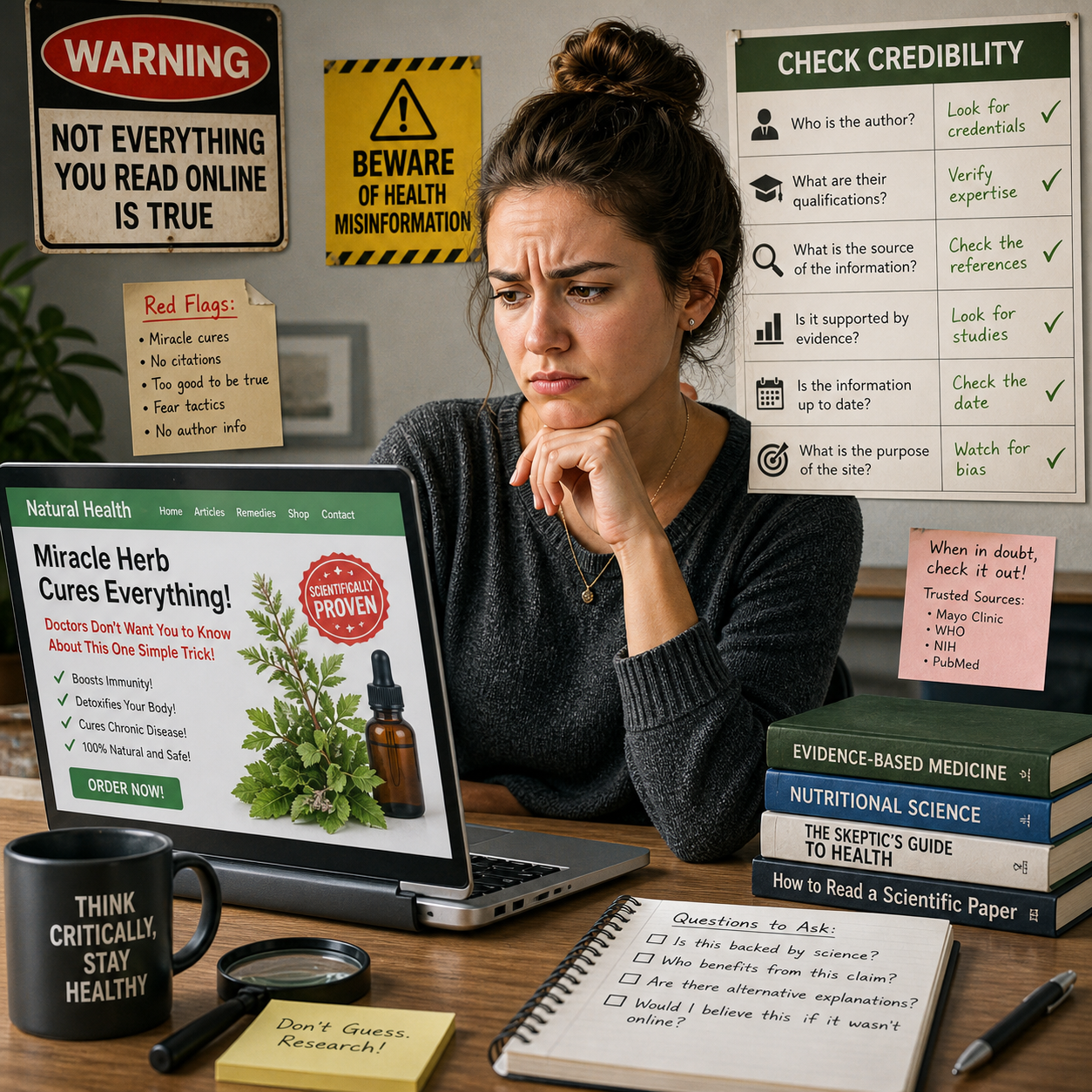
The most consistent warning signs: no identifiable author, or authorship attributed to nothing more specific than 'staff writer.' An 'About Us' page that's either missing or deliberately vague. No references to peer-reviewed research anywhere on the site. Headlines engineered to trigger fear or excitement rather than inform. And aggressive monetization — pop-up ads for supplements every few paragraphs, or articles that somehow always conclude you need to buy a specific product. Any one of these should make you pause. Multiple at once? Leave immediately.
Checking Author Credentials and Editorial Standards
On a site like Mayo Clinic or Healthline, you can find out exactly who wrote what you're reading. You'll see a name, their credentials (MD, RN, RD — real designations attached to real licensure), and often an explicit note that the piece was reviewed by a licensed medical professional before it went live. That kind of transparency is standard on legitimate health platforms. When I land on a health page and there's no author listed at all — or the 'author' is a first name with no verifiable background — that's an immediate stop sign for me.
Editorial standards carry equal weight. Trustworthy sites publish their review processes. They link to actual studies, not just gesture vaguely at 'research.' And they update their content — because medicine changes, and a site that cares about accuracy reflects that. If I find a 'complete guide to managing heart disease' that was last updated in 2019 and has zero citations, I'm gone. The information might be fine, but I have no way to know that, and that's the point.
Spotting Misleading Claims and Pseudoscience Language
Bad health content has its own dialect, and it's worth learning. The tell-tale phrases: 'toxin cleanse,' 'miracle cure,' 'doctors don't want you to know this,' 'Big Pharma is hiding it,' or the classic 'scientifically proven' with zero actual science attached. Also watch for any claim that one product or one habit can somehow cure multiple unrelated conditions. That's not how medicine works, and anyone writing as if it does is either misinformed or deliberately misleading you.
Vague language is its own category of red flag. 'Supports immune health.' 'Promotes cellular renewal.' These phrases sound scientific. They aren't. A legitimate medical claim explains a mechanism, cites evidence, and can be checked against independent sources. Pseudoscience dresses up in scientific-sounding words precisely because it can't survive actual scrutiny. The vagueness isn't an accident — it's a feature.
How to Verify a Health Source Before Trusting It
My verification process takes maybe five minutes, and I've lost count of how many times it's kept me from acting on bad information. I start with who wrote the content — real name, real credentials, verifiable background. Then I look at the domain itself: who owns it, when it was registered, and whether the site's stated purpose actually matches what it's publishing.
That last part is something most people skip entirely, and it matters more than almost anything else. A URL that sounds health-related is completely meaningless on its own. Take Mostbet online as an illustration — the domain includes a word that translates to 'health' in Polish, which could easily make a quick reader assume they've landed on a legitimate wellness resource. But the site has nothing to do with health information. That's exactly the kind of mismatch I'm talking about: a health-sounding address being used to host entirely unrelated commercial content. Never let a URL do your credibility check for you.
For actual fact-checking, I keep a short list of tools I trust. PubMed (pubmed.ncbi.nlm.nih.gov) gives you direct access to peer-reviewed medical research. The CDC and NIH sites publish government-backed, evidence-based information. MedlinePlus, run by the National Library of Medicine, is especially good for patient-friendly explanations of conditions and treatments — it's where I send family members who need something clear and reliable. If a claim I've read somewhere can't be confirmed on any of these platforms, I treat that absence as a warning sign, not a gap to fill with the original source's word.
Using WHOIS and Transparency Tools to Investigate a Website
You don't need any technical background to do this. WHOIS (whois.domaintools.com) is a free tool that tells you when a domain was registered, who registered it, and where it's hosted. A health website that appeared six months ago, has its ownership hidden behind a privacy proxy, and is hosted in a country that has nothing to do with its claimed audience — that site is almost certainly not a legitimate medical resource. The combination of those three factors alone is disqualifying for me.
I also run sites through the Wayback Machine (web.archive.org) to see what a domain was doing before it became a 'health resource.' This one surprises people. If a domain was hosting a gambling platform or a retail store six months ago and recently rebranded as a wellness site, that's a major credibility problem. Real health organizations build their presence over years. The history is visible — and it tells you a lot.
Trustworthy Health Resources Americans Should Bookmark in 2026
After years of sorting through this landscape, here's the shortlist I actually use and recommend to everyone I know:
- CDC (cdc.gov) — The Centers for Disease Control and Prevention. Essential for infectious disease information, vaccination schedules, and public health data.
- NIH (nih.gov) — The National Institutes of Health. Offers deep research resources and links to clinical studies.
- FDA (fda.gov) — Critical for verifying drug safety, supplement claims, and food safety information.
- MedlinePlus (medlineplus.gov) — Patient-friendly health information from the National Library of Medicine.
- Mayo Clinic (mayoclinic.org) — Physician-reviewed condition and treatment information with strong editorial controls.
- Cleveland Clinic Health Library — Another academic medical center resource with genuinely solid editorial standards.
- Harvard Health Publishing — Evidence-based wellness content from one of the country's leading medical schools.
Brand recognition plays a role here, but it's not the whole story. What actually makes these sources trustworthy is the infrastructure behind them: transparent editorial processes, credentialed authors, clear citation practices, and real accountability to professional and regulatory standards. They have something to lose if they get it wrong. That accountability matters.
The Role of Social Media in Spreading Health Misinformation
In 2026, TikTok, YouTube, and Instagram are still the most powerful vehicles for health misinformation in the United States. The reason is structural, not accidental. These platforms are built to maximize engagement, and emotionally charged health content — fear, hope, outrage, miracle stories — performs extremely well by every metric they optimize for. A video claiming a common food causes cancer will pull dramatically more views than a careful, nuanced explanation of nutritional risk factors. The algorithm doesn't care which one is true.
Influencers with huge followings and zero medical training hand out health advice constantly, often while getting paid to promote the supplements or products they're recommending. Sponsored content disclosures are buried, ignored, or absent entirely. My personal rule: if someone's main qualification for dispensing health advice is their follower count, I extend their medical claims the same skepticism I'd give a stranger on a bus who wanted to tell me about a cure they'd read about.
When I'm evaluating a health video, I ask four things: Does this person cite their sources? Do they acknowledge that medicine involves complexity and uncertainty? Are they selling something tied to their claims? And do actual credentialed health professionals agree with what they're saying? Those four questions cut through the vast majority of problematic content without much effort.
Teaching Digital Health Literacy to Your Family
One of the more valuable things I've done for my household is making these conversations explicit — not assuming that everyone already knows how to evaluate what they read online. Kids today are digital natives, which sounds like it should mean they're naturally skeptical. It often means the opposite. They're fast, comfortable, and confident online, but that fluency doesn't automatically translate to critical reading. And older relatives are frequently the primary targets of health misinformation campaigns — they tend to trust authoritative-looking sites precisely because the design looks official.
A few things that have genuinely worked for me:
- Create a simple 'three-source rule' with your family: before acting on any health claim, check it against at least three credible, independent sources.
- Look at websites together and identify red flags as a group — with kids especially, turning it into a game makes it stick.
- Bookmark the trusted resources listed above on every family member's device, not just your own.
- When someone shares health content on social media, respond with gentle curiosity rather than judgment: 'That's interesting — do you know where they got that from?'
- Check out the health literacy resources from the National Library of Medicine and the CDC's health literacy initiative — both offer free materials built for different age groups, and they're genuinely useful.
The goal isn't to turn everyone into a medical researcher. It's to build enough of a pause reflex that people don't act on health claims the moment they encounter them online. That small habit — stopping for five minutes before doing something based on something you read — is more protective than most people realize.
Conclusion — Protecting Your Health Starts With Protecting Your Information Diet
I keep coming back to this comparison: health information is like food. You wouldn't eat something without at least some basic sense of where it came from and whether it was safe. The same logic applies to the health advice you absorb online. In 2026, the sheer volume of health content competing for your attention is staggering — and a meaningful chunk of it is, at best, useless noise, and at worst, genuinely dangerous guidance that could send someone down a harmful path.
The tools to protect yourself are free, accessible, and learnable with practice. Checking who wrote something, verifying who owns a domain, cross-referencing claims with the CDC and NIH, recognizing the specific language patterns of pseudoscience — none of this requires a medical degree. It requires a habit. And that habit — spending five deliberate minutes before acting on health information you found online — could protect you, or someone you love, in ways that are hard to overstate.
Treat your information diet with the same care you'd bring to your actual diet, or to your medical care. Your health depends on both.